
1. The End of the Black-Box Era
For the past two years, enterprise AI coding strategy has been dominated by a convenient illusion: the all-in-one cloud monolith. Turnkey solutions like Claude Code or GitHub Copilot wrapped the orchestration agent, the frontier LLM, and the cloud hosting environment into a single subscription. For rapid prototyping, this zero-setup model delivered immediate developer velocity. However, as enterprise adoption scales from individual developer sandboxes to hundreds of engineering teams, the strategic drawbacks of these proprietary black boxes have become painful board-level risks.
Enterprise technology leaders now face three systemic bottlenecks:
- Uncapped Cloud Financial Liabilities: Sourcing frontier models (e.g., Claude 3.5 Sonnet or GPT-4o) for routine, low-level coding tasks means paying top-tier, per-token rates for boilerplate generation and basic file reads.
- Intellectual Property & Regulatory Exposure: Transmitting propriety codebases, architectural schemas, and confidential client logic across third-party cloud APIs violates strict sovereign data policies, financial regulations, and corporate security guidelines.
- Vendor Lock-In & Zero Architectural Control: Cloud monoliths dictate which models run, how context is managed, where inference occurs, and how work is split. Organizations are left unable to optimize price, latency, or model selection for specialized domain tasks.
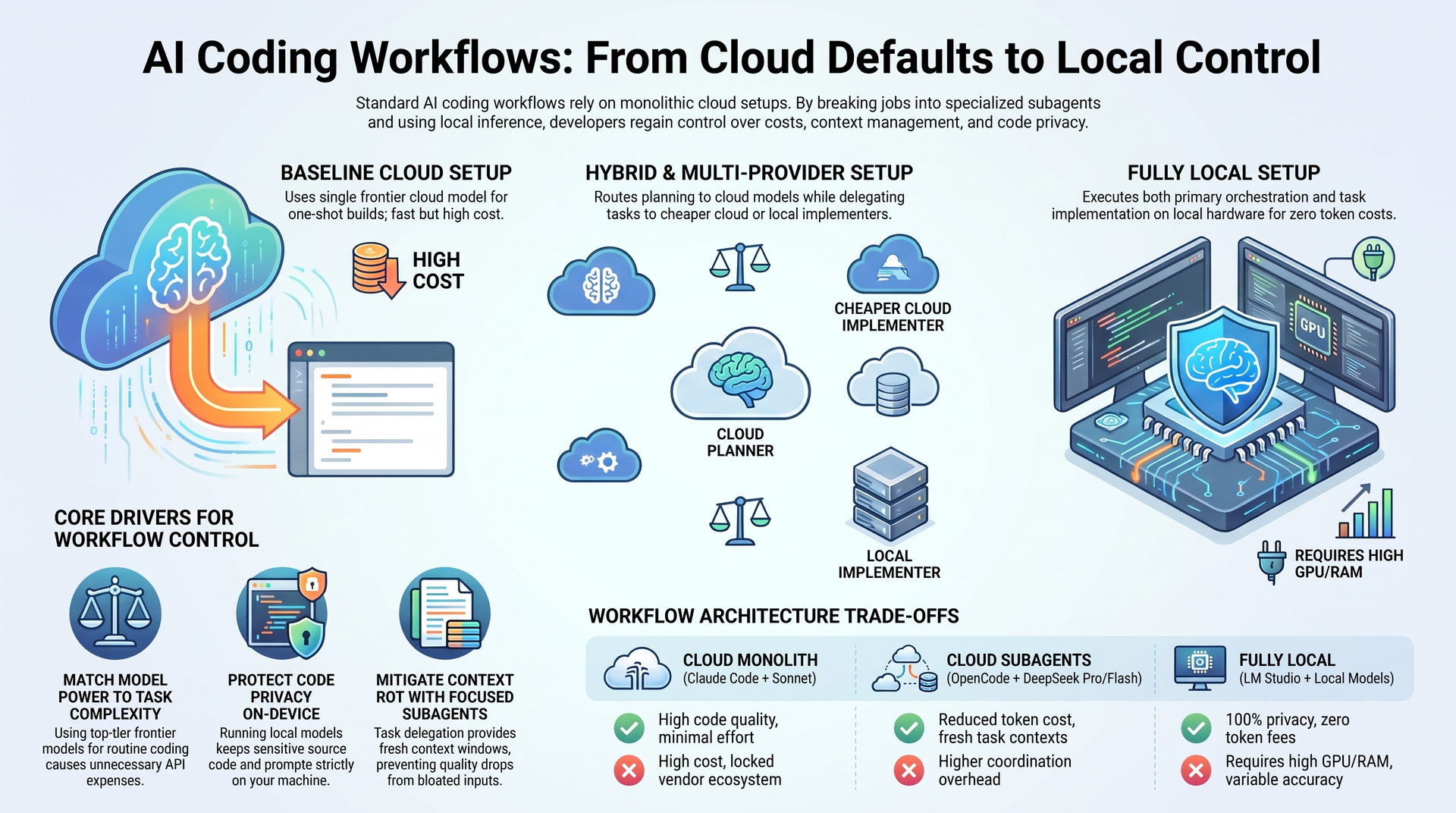
A fundamental paradigm shift is underway. Leading enterprise AI solutions architects are transitioning away from passive vendor consumption toward active architectural governance. By systematically decoupling the three layers of the AI development stack—the coding agent (harness), the inference routing layer, and the underlying language models (cloud vs. local) - enterprises can unlock unprecedented operational efficiency, total IP sovereignty, and dramatic cost optimization.
2. Strategic Capabilities & Business Value
Decoupling the AI engineering stack turns static software tools into a controllable, multi-agent enterprise infrastructure [7, 19]. This architectural evolution yields four strategic capabilities:

I. Cost Optimization via Dynamic Model Tiering
In a monolithic setup, a single high-cost model performs every action—from high-level software architecture to writing simple unit tests and parsing directory logs. Decoupling enables the "Big Brain / Little Brain" architectural pattern: a frontier cloud model serves as the orchestrating architect ("Big Brain"), while lightweight, open-weight models or specialized Small Language Models (SLMs) execute bounded, routine implementation tasks ("Little Brain"). Empirical data demonstrates that offloading implementation to cheaper or local models cuts per-task cloud token spend by 28% to 80%+ without degrading code quality.
II. Absolute Intellectual Property Sovereignty
For enterprise legal and compliance officers, sending source code to external public APIs represents an unacceptable security risk. Decoupled architecture allows engineering teams to run high-performance open-weight models (such as Gemma 4 12B or Qwen 3.5 27B) entirely on local workstation hardware or enterprise on-premises private clouds. Sensitive IP, internal API specs, and proprietary algorithms never leave the corporate firewall.
III. Mitigating "Context Rot" via Spec-Driven Multi-Agent Systems
As AI coding sessions grow longer, accumulating hundreds of lines of chat history and tool outputs, LLMs suffer from Context Rot. Attention mechanisms degrade under noisy, oversized inputs, causing models to miss instructions, hallucinate invalid code syntax, or overwrite existing features. By implementing Spec-Driven Development (SDD) and delegating tasks across short-lived subagents with fresh, isolated context windows, enterprises maintain peak model accuracy throughout complex software builds.
IV. Future-Proofed Ecosystem Resilience
The AI model landscape evolves weekly. Proprietary lock-in forces enterprises to adapt their internal workflows around a single provider's product roadmap. Open agent harnesses supporting protocols like the Agent Client Protocol (ACP) and standardized OpenAI-compatible inference APIs ensure that enterprises can swap out underlying models, cloud routing providers, or local inference backends instantly without disrupting developer workflows.
3. Under-the-Hood Architectural Rigor: From Cloud to Fully Local
To prove technical feasibility and operational readiness, we analyze the progression across four production-grade architectural topologies evaluated against a standardized enterprise application build (Agent Clinic / Agent Complaints FastAPI App).

Topology A: The Cloud Monolith (Claude Code Baseline)
- Architecture: Local CLI client connecting directly to a proprietary cloud frontier model (Anthropic Claude 3.5 Sonnet).
- Execution Mechanism: One-shot-prompt attempting to plan, generate code, run tests, and debug the entire application in a single continuous context window.
Empirical Metrics:
- Main Agent Context: ~217k tokens processed across 7 interaction turns.
- Implicit Subagent Behavior: The harness autonomously spawned a subagent consuming 54% of context and 61% of tool calls.
- Architectural Diagnosis: High speed and immediate code generation, but zero governance over model selection, unconstrained cloud billing, and extreme vulnerability to context rot as feature complexity expands.
Topology B: Multi-Agent Cloud Routing & Model Tiering (OpenCode + OpenRouter + DeepSeek)
- Architecture: Transition to an open coding harness (OpenCode) via the Agent Client Protocol (ACP), routed through OpenRouter to decoupled model providers.
- Execution Mechanism: The "Big Brain / Little Brain" pattern. DeepSeek V4 Pro handles high-level orchestration, while custom subagents running on DeepSeek V4 Flash handle routine code implementation.
Empirical Metrics:
- Context Redistribution: 8 small, task-focused implementer subagents replaced 2 massive monolithic sessions.
- Context Efficiency: Average context per subagent session dropped from 694k tokens down to 110k tokens.
- Economic Impact: Metered cloud costs fell by 28%, despite a 56% increase in interaction turns, due to the dramatic price differential between frontier and flash-tier inference.
Topology C: The Hybrid Enterprise Architecture (Cloud Orchestrator + Local On-Prem Subagent)
- Architecture: Cloud-based orchestrator (DeepSeek Flash via OpenRouter) delegating sub-tasks to a local inference server (LM Studio) running an open-weight Small Language Model (Gemma 4 12B IT / Qwen 3.5 9B) on standard 16 GB workstation hardware.
Execution Mechanism (Spec-Driven Handoffs):
- Project Constitution: The project is governed by strict specs—mission.md, tech-stack.md, and an itemized roadmap.md.
- Handoff Packets: The cloud orchestrator prepares a structured, self-contained Handoff Packet containing exact file snippets, target objectives, and test execution requirements.
- Hardened Subagent Definition (implementer.md): Programmatic guardrails set a step ceiling (max 12 steps), restrict file access, disable recursive directory scanning, and enforce the use of whole-file write operations over diff-based edit tools (which small models frequently corrupt).
Empirical Metrics:
- Billed Cloud Cost: Reduced to a negligible ~$0.02 per full feature build (only covering main agent cloud coordination).
- Execution Wall-Clock: 8 minutes 52 seconds of stable, deterministic execution on local workstation compute.
Topology D: Fully Sovereign On-Prem Execution (Local Architect + Local Subagent)
Architecture: 100% air-gapped, on-premise execution environment running on 32 GB workstation hardware.
- Local Orchestrator ("Big Brain"): Qwen 3.5 27B (Q4 Quantization, MLX/GGUF format, ~21 GB VRAM footprint, tuned to an 80k token context window).
- Local Implementer ("Little Brain"): Gemma 4 12B IT (8-bit quantization, ~12.7 GB VRAM).
- Execution Mechanism: Multi-stage feature loop where the local Qwen 27B model parses project specs, writes refined handoff packets, delegates tasks to the local Gemma 12B implementer, and autonomously reviews test execution logs.
Empirical Metrics:
- Billed Cloud Cost: $0.00 (Zero Usage Billing).
- Data Privacy & IP Control: 100% On-Premises Sovereignty—zero bytes leave corporate hardware.
- Model Behavioral Insights: Total turns increased to 45 (vs 6 in cloud baseline), while tool calls remained constant (57 vs 51). This proves that local SLMs adopt a highly conversational, step-by-step verification style rather than performing excessive unguided work.
4. Operational Leadership Blueprint: Enterprise Implementation & Risk Governance
Translating these engineering realities into enterprise-grade capability requires moving from informal "vibe coding" to structured Agentic Software Engineering. Technology leaders must establish five operational pillars:

1. Mandate Spec-Driven Development (SDD) Protocols
Enterprise developers must not be permitted to send loose, unstructured prompts to AI agents. Every project must establish a Project Constitution containing:
- mission.md: Explicit business logic and scope boundaries.
- tech-stack.md: Permitted libraries, framework versions, and architectural standards.
- roadmap.md: Granular, step-by-step feature tasks designed for subagent consumption.
2. Standardize Hardened Agent Definitions (.opencode/agents/)
Subagent configurations must be version-controlled assets stored directly in enterprise repositories. Definitions for lower-tier local models must programmatically enforce:
- Execution Step Ceilings: Setting max steps (e.g., limit = 12) to prevent infinite loops and runaway compute spend.
- Tool Permitting & Permission Boundaries: Explicitly disabling recursive directory scanning and restricting access to destructive CLI commands.
- Deterministic File Operations: Forcing small models to use full-file write tools rather than search-and-replace edit diffs.
3. Embed Automated CI/CD Testing into Handoff Packets
To prevent small models from hallucinating or delivering broken code, the orchestrating agent must embed automated test execution (pytest) directly into the subagent handoff packet. Subagents are instructed to run tests, capture stdout/stderr, and report failures without attempting unguided, endless repair loops.
4. Hardware Sizing & Precision Quantization Strategy
Enterprise workstation procurement must align with local model memory requirements:
- Standard Engineering Tier (16 GB RAM): Supports 8-bit quantized 9B–12B SLMs (Gemma 4 12B IT) running as local implementers under a tuned 40k context window.
- Senior Architect / AI Specialist Tier (32 GB–64 GB Unified Memory): Supports 4-bit quantized 27B–32B models (Qwen 3.5 27B Q4) capable of acting as full local orchestrators under an 80k context window.
5. Establish Enterprise Cost & Privacy Routing Policies
CTOs must institute clear data classification policies for AI inference routing:
- Public / Unclassified Core Logic: Routed via model gateways (OpenRouter/Private Proxy) to cost-efficient cloud providers (DeepSeek Pro/Flash).
- Proprietary IP / Regulated Codebases: Strictly locked to local on-premises inference endpoints (LM Studio / Ollama / Private vLLM Clusters).
5. Summary Matrix: Quantitative Architecture Comparison
|
Architectural Topology |
Coding Agent (Harness) |
Orchestrator ("Big Brain") |
Implementer ("Little Brain") |
Metered Cloud Cost |
Data Sovereignty / IP Privacy |
Context Efficiency & Risk |
|
Topology A: Cloud Monolith |
Claude Code |
Cloud Sonnet 3.5 |
Cloud Sonnet (Implicit) |
100% Baseline (Highest) |
Low (Full code sent to third-party cloud) [7, 15] |
Vulnerable to Context Rot in long sessions [77, 85] |
|
Topology B: Multi-Agent Cloud |
OpenCode (ACP) |
DeepSeek V4 Pro |
DeepSeek V4 Flash (Subagent) |
28% Cost Reduction vs Cloud Subagents [179, 196] |
Medium (Billed cloud tokens via router) [126, 138] |
High (8 subagent sessions @ 110k context avg) [179, 194] |
|
Topology C: Hybrid Enterprise |
OpenCode (ACP) |
DeepSeek Flash (Cloud) |
Gemma 4 12B IT (Local 16GB) [201, 221] |
~ $0.02 Billed Cost per run [228, 257] |
High (Code implementation stays on-prem) [7, 199, 305] |
High (Hardened implementer.md & guardrails) [223, 237-240] |
|
Topology D: Fully Sovereign |
OpenCode (ACP) |
Qwen 3.5 27B Q4 (Local 32GB) [261, 273] |
Gemma 4 12B IT (Local 32GB) [261, 275] |
$0.00 (Zero Cloud Bill) [266, 292] |
100% Air-Gapped / Absolute Sovereignty [7, 266, 305] |
Maximum (Zero external dependency) [266, 292, 305] |
6. Forward-Looking Conclusion: The Strategic Horizon
The era of relying on one-size-fits-all cloud monoliths for enterprise software development is drawing to a close. The future of software engineering belongs to organizations that master sovereign, multi-agent AI orchestration.
By decoupling the coding harness from underlying inference models, enterprise technology leaders achieve the ultimate strategic triad: uncompromised IP security, drastic cost reduction, and architectural agility.
As open-weight models become increasingly powerful and agentic harnesses mature, the capability gap between cloud frontier models and local hardware is closing rapidly. Organizations that establish spec-driven development, hardened subagent definitions, and hybrid inference routing today will lead the next decade of autonomous, resilient enterprise software engineering.
Artifact Reference: 2552e8f0-27c9-4d70-8681-634429b9e6fa