
Executive Summary
Transitioning an enterprise engineering department from consumer-grade monolithic AI plugins to a production-grade, multi-agent AI software factory requires precise tactical execution.
This playbook provides a step-by-step implementation roadmap synthesized from benchmark evaluations across four core topologies. It details how to configure open agent harnesses (OpenCode via Agent Client Protocol / ACP), establish model routing layers (OpenRouter), set up local inference servers (LM Studio), and harden subagent specifications to achieve up to 100% data sovereignty and 80%+ cost reduction.
1. Hardware Sizing & Infrastructure Matrix
|
Hardware Tier |
Memory / VRAM Profile |
Local Orchestrator ("Big Brain") |
Local Implementer ("Little Brain") |
Context Limit |
Performance |
|
Standard Workstation |
16 GB RAM |
DeepSeek Flash (Cloud) |
Gemma 4 12B IT (8-bit, ~12.7GB VRAM) |
32k - 40k tokens |
~25 tokens/sec |
|
Advanced Workstation |
32 GB RAM |
Qwen 3.5 27B IT (Q4, ~21GB VRAM) |
Gemma 4 12B IT (8-bit) |
64k - 80k tokens |
~18 tokens/sec |
|
Enterprise AI Rig |
64 GB+ RAM |
Qwen 3.5 27B IT (FP16) |
Qwen 3.5 9B / Gemma 12B |
128k tokens |
~45 tokens/sec |
2. Environment Setup Runbook
Step 1: OpenCode Harness Setup
OpenCode is an open-source CLI harness operating over the Agent Client Protocol (ACP), decoupling agent UI from underlying inference APIs.
- Deploy the OpenCode CLI binary to team developer machines.
- Verify ACP engine status with opencode version.
Step 2: Configure Model Routing
Set configuration in global provider config files to manage cloud routers and local endpoints.
Step 3: LM Studio Setup
- Launch LM Studio on developer workstations.
- Load models: Gemma 4 12B IT (8-bit) and Qwen 3.5 27B Instruct (Q4).
- Enable local server on port 1234 with context window size set to 40,960 tokens.
3. Hardening Subagent Configurations
Subagents operate as automated micro-executors. To prevent unexpected behavior, small-model diff corruption, and runaway token consumption, create explicit subagent specs in repository roots:
Implementer Configuration Specification
- Role: Bounded local implementation specialist.
- Tools Enabled: write (force whole-file overwrites), edit (disabled to prevent search-and-replace diff errors), bash (permitted for test execution), ls (disabled), find (disabled).
- Execution Ceilings: max_steps set to 12 (hard termination limit).
- Strict Execution Rules: Execute only the task defined in the Handoff Packet. Never scan virtual environment or git dependency directories. Write complete, working files using whole-file write tool. Run unit tests before completing.
4. Spec-Driven Handoff Execution Workflow
To demonstrate operational execution, we trace the build of a standardized enterprise service:
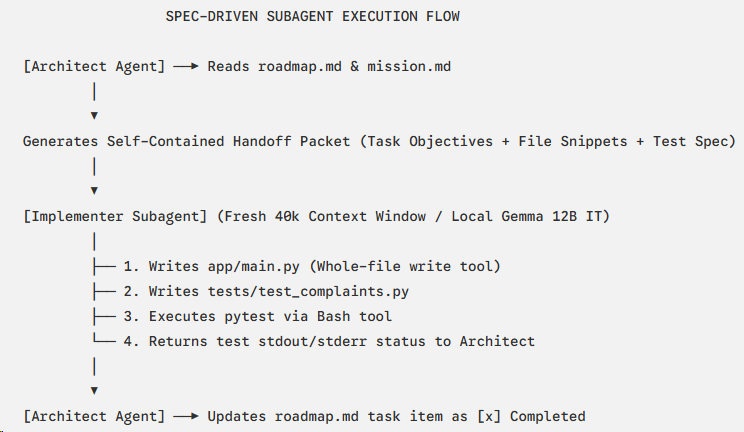
Handoff Packet Structure
Passed directly from the Architect agent to the Implementer subagent:
- Objective: Itemized target feature (e.g., POST endpoint implementation).
- Constraints: Approved frameworks (FastAPI, Pydantic v2) and mandatory file targets (app/main.py, tests/test_complaints.py).
- Verification: Automated test command specification (pytest tests/test_complaints.py).
5. Operational Realities & Resolution Protocols (Tips & Tricks)
During enterprise rollouts, engineering teams will encounter specific behaviors across small models and local inference backends. Use these battle-tested resolution protocols:
Operational Nuance 1: Small Model Diff Handling
- Symptom: Models with <15B parameters hallucinate line numbers or fail to match exact string patterns when using search-and-replace edit tools.
- Resolution: Disable edit tool and enable write tool in subagent configuration. Force the subagent to re-write entire files. For small files (<300 lines), whole-file writing is 100% deterministic and eliminates syntax corruption.
Operational Nuance 2: Execution Loops & Step Ceilings
- Symptom: A subagent encounters a failing test and repeatedly executes tests without fixing the bug, consuming compute or hanging local hardware.
- Resolution: Enforce step limits (max_steps: 12) in subagent config. Force the subagent to report failure back to the primary Architect agent after 12 steps, allowing the higher-capacity Architect model to diagnose the issue.
Operational Nuance 3: Context Degradation ("Context Rot") from Virtual Environments
- Symptom: Harness context token count explodes to 200k+ tokens on step 2 due to recursive file searching.
- Resolution: Add .venv, node_modules, .git, and dist to ignore files. Instruct subagents explicitly in prompt instructions to ignore dependency directories.
Operational Nuance 4: Local Server Timeouts in LM Studio
- Symptom: Local inference calls fail with connection timeout during heavy subagent execution.
Resolution: In LM Studio server settings:
- Increase Keep Model in Memory Timeout to Infinity.
- Increase Context Window Size explicitly to 40960.
- Enable GPU Acceleration offloading to 100% of layers.
6. Enterprise Migration Roadmap: A 4-Phase Execution Blueprint

- Phase 1: Protocol Standardization (Weeks 1–2): Replace monolithic plugins with open ACP harnesses (OpenCode). Establish central OpenRouter billing with Zero-Data-Retention (ZDR).
- Phase 2: Spec-Driven Integration (Weeks 3–4): Require all engineering teams to embed Project Constitutions (mission.md, tech-stack.md) and hardened agent YAMLs into repository templates.
- Phase 3: Hybrid Local Offloading (Weeks 5–6): Deploy 16GB local developer workstations with LM Studio. Route subagent implementer tasks locally while keeping high-level cloud planning. Achieve 80%+ metered cloud cost savings.
- Phase 4: Full Sovereign Infrastructure (Weeks 7–8): Deploy 32GB/64GB local rigs running local Qwen 27B orchestrators for classified, air-gapped repositories. Achieve complete IP privacy and $0.00 metered compute costs.
Artifact Reference: 2552e8f0-27c9-4d70-8681-634429b9e6fa