
1. The Sovereign Knowledge Paradigm
The enterprise artificial intelligence narrative has crossed a definitive threshold. Over the past twenty-four months, boardroom discussions have progressed from speculative fascination with generative models to a disciplined interrogation of enterprise value, intellectual property protection, and operational return on investment.
Every major enterprise sits on vast repositories of proprietary "dark data"—unstructured internal documentation, engineering schematics, regulatory compliance filings, customer interaction transcripts, and institutional memos. While public foundation models demonstrate remarkable linguistic reasoning, they remain fundamentally blind to proprietary enterprise reality. Retraining or fine-tuning foundation models on corporate data is economically unsustainable, operationally rigid, and introduces acute governance risks, including the potential leakage of sensitive intellectual property into model weights.
Retrieval-Augmented Generation (RAG) has established itself as the definitive architectural paradigm for the cognitive enterprise. By decoupling parameterized linguistic computation from private knowledge storage, RAG equips language models with a dynamic, verifiable working memory directly grounded in corporate source repositories.
Yet across enterprise technology teams, an alarming gulf has opened between prototype velocity and production resilience. Deploying a rudimentary retrieval script in a development sandbox takes less than an hour; operationalizing a fault-tolerant, compliant, and low-latency cognitive platform across global business units requires deep systems engineering. When organizations treat retrieval as a black-box commodity, they invariably collide with severe failure modes: context-window bloat, hallucinatory extrapolation, structured query blindness, and catastrophic amnesia in multi-turn dialogues.
Transitioning from experimental proofs-of-concept to institutional enterprise capability demands that technology leaders look beneath the hood, understand the structural physics of retrieval orchestration, and guide their engineering organizations from brittle experimentation to industrial-scale execution.
2. Strategic Capabilities: Unlocking the Enterprise's Dark Data
Traditional enterprise search was built on lexical keyword matching. It answered where a specific token lived inside a repository, leaving the exhausting labor of reading, cross-referencing, and synthesizing disparate documents entirely to human analysts. Conversely, production RAG synthesizes semantic search with generative deduction, unlocking transformative business capabilities across three dimensions:
Compressing Analytical Latency from Days to Seconds
In high-stakes corporate environments—such as clinical trial evaluation, legal contract due diligence, financial underwriting, and complex systems engineering—knowledge workers spend between thirty and forty percent of their working hours searching for and reconciling fragmented documentation. An enterprise-grade RAG architecture enables professionals to pose multi-variable natural language inquiries across millions of pages and receive verified, synthesized answers in sub-second latency.
Immutable Provenance and Auditability
Unlike pure foundation models whose answers represent probabilistic completions divorced from direct citations, an engineered RAG pipeline returns exact source attributions down to the document name, page number, and paragraph coordinates. This deterministic audit trail is non-negotiable for enterprise compliance in regulated environments governed by bodies such as FINRA, HIPAA, and GDPR.
Dynamic Knowledge Adaptation Without Model Drift
Fine-tuning large language models on proprietary data creates brittle snapshots of enterprise truth that instantly degrade as policies evolve and documentation updates. In a RAG topology, updating enterprise intelligence requires zero model retraining. The moment an updated policy document is ingested into the vector database, the system immediately reasons over the new facts while previous iterations are automatically deprecated through metadata version control.
3. Under-the-Hood Architectural Rigor: Deconstructing the Five Pillars of RAG
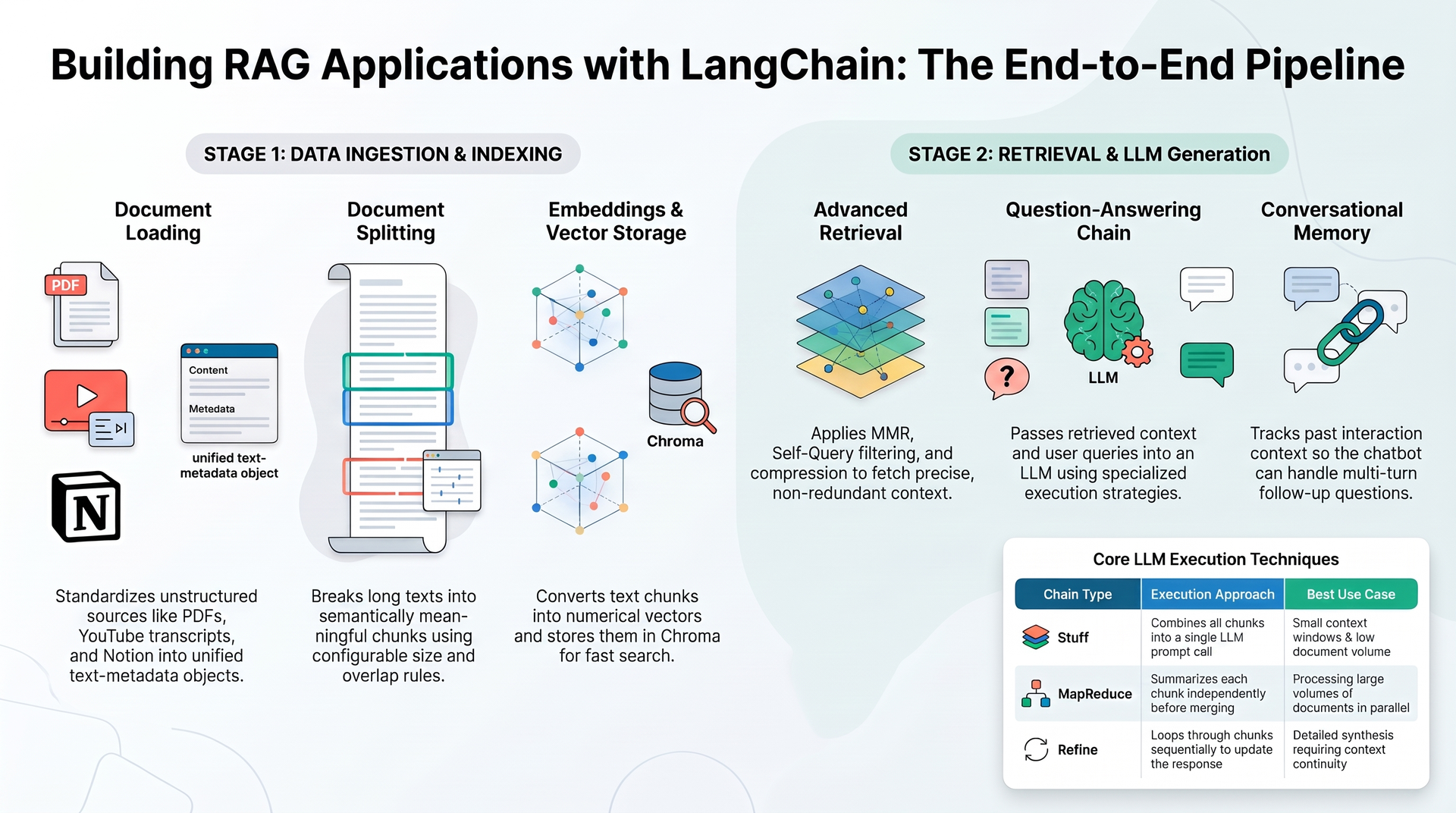
True executive leadership in artificial intelligence requires an uncompromised grasp of the underlying engineering pipeline. Using the modular abstractions pioneered by LangChain, a resilient enterprise RAG system is structured around five foundational engineering pillars, moving progressively from raw data acquisition to contextual synthesis:
|
Architectural Pillar |
Core Technical Mechanism |
Enterprise Role & Function |
|
I. Document Ingestion |
Format-specific parsing (80+ loaders) and metadata enrichment |
Normalizes heterogeneous corporate data while binding source lineage. |
|
II. Semantic Splitting |
Recursive character segmentation and token boundary calibration |
Preserves contextual coherence and eliminates sentence fragmentation. |
|
III. Vector Representation |
High-dimensional geometric embeddings and persistent vectorstores |
Maps textual meaning into searchable mathematical vector spaces. |
|
IV. Advanced Retrieval |
Maximal Marginal Relevance, self-querying, and contextual compression |
Filters noise, eliminates duplicates, and enforces structured constraints. |
|
V. Generation & Memory |
Multi-stage chain topologies and automated query condensation |
Synthesizes answers, manages conversational state, and ensures low latency. |
Pillar I: Multi-Source Document Ingestion and Normalization
The foundation of any cognitive architecture is the loading layer. Enterprise data is inherently messy and format-heterogeneous, encompassing multi-column PDFs, internal Notion wikis, scanned regulatory binders, corporate intranet HTML, and audio/video transcripts.
- Format-Specific Loaders: Ingestion pipelines deploy specialized loaders (such as PyPDF loaders, structured Markdown parsers, and web document extractors) designed to preserve document topology. In LangChain, over eighty specialized document loaders enable the ingestion of unstructured text from diverse sources, converting them into standardized document objects consisting of page content and structured metadata.
- Metadata Engineering: Ingestion is not merely text extraction; it is metadata capture. Every ingested chunk must be systematically enriched with structural and governance metadata: source document identifiers, canonical URIs, publication timestamps, author classifications, and department-level security access tags. Without rigorous metadata tagging at ingestion, downstream role-based access control and temporal filtering become impossible.
Pillar II: Semantic Document Splitting and Boundary Geometry
Passing entire multi-megabyte documents directly into language models is computationally unfeasible and contextually disastrous. Text must be segmented into semantically coherent chunks, a process governed by intricate structural geometry.
- The Fallacy of Naive Character Splitting: Splitting text purely on arbitrary character counts ruthlessly severs sentences, separating qualifying conditions from governing principles (for example, breaking a legal clause like "except where prohibited by state jurisdiction" from its primary liability waiver).
- Recursive Character Splitting Hierarchy: Production pipelines rely on recursive character text splitters that navigate a deliberate hierarchy of natural semantic boundaries: double line breaks (paragraphs), single line breaks (sentences), spaces (words), and finally individual characters. This guarantees that paragraphs and sentences remain intact as cohesive logical units.
- Structure-Aware Markdown Splitting: For structured enterprise knowledge bases, specialized header splitters partition content according to logical headers (such as primary, secondary, and tertiary headers), automatically appending the hierarchical header path to the metadata of every resulting chunk.
- The Overlap Cushion: To preserve context across chunk boundaries, engineering teams calibrate a strict chunk overlap ratio—typically ten to twenty percent of chunk size. This ensures that semantic continuity and pronoun references are maintained across adjacent chunks.
- Token-Level Calibration: Because language models operate on token vocabularies rather than raw character counts, splitters must be calibrated to the specific tokenizer of the target generation model, guaranteeing that chunks never overflow model context limits.
Pillar III: Geometric Embedding Spaces and Vector Storage
Once text is segmented, it must be translated into mathematical representations that capture semantic meaning.
- High-Dimensional Embedding Vectors: Embedding models map unstructured text strings into dense vector spaces (frequently spanning 1,536 dimensions). In this geometric space, semantic similarity corresponds to mathematical proximity, calculated via cosine similarity or dot product metrics. Chunks describing identical corporate policies cluster together, even if they share zero identical keywords.
- Vectorstore Persistence and Indexing: Embeddings are indexed within dedicated vector stores such as Chroma. While developmental sandboxes utilize ephemeral in-memory storage that vanishes upon session termination, enterprise production systems require persistent disk backing, decoupled database clusters, and optimized index structures that allow sub-50-millisecond nearest-neighbor lookups across hundreds of millions of embeddings.
Pillar IV: Advanced Retrieval Mechanics (Overcoming Naive Similarity)
In naive RAG implementations, systems perform simple cosine similarity search to retrieve the top candidate chunks. In enterprise production, naive retrieval fails consistently. Production resilience requires three advanced architectural layers:
- Maximal Marginal Relevance (MMR) for Diversity: When corporate repositories contain duplicate documents or highly repetitive phrasing, standard similarity search returns identical chunks, consuming prompt context without providing new information. MMR dynamically balances semantic relevance with diversity, retrieving a broad candidate pool and selecting a final subset that eliminates redundancy.
- Self-Querying Metadata Filtering: When an executive asks, "What was our Q3 guidance in the 2024 annual review?", the query contains two distinct information types: a semantic topic (guidance) and structured metadata constraints (Q3, 2024). Naive semantic search blurs these together. A self-querying retriever uses a lightweight model to parse natural language into structured metadata filters combined with a clean semantic query, ensuring absolute precision.
- Contextual Compression: Standard chunks often contain eighty percent irrelevant boilerplate and only twenty percent crucial factual evidence. Contextual compression pipelines pass candidate chunks through an extraction filter that discards distractor tokens, passing only the concentrated factual signal into the final generation prompt.
Pillar V: Multi-Stage Generation Chains and Conversational State
The final pillar synthesizes retrieved factual context with user queries to generate executive-ready answers.
Chain Selection Trade-offs: Architecture teams must balance latency against analytical breadth by selecting the optimal chain topology:
- Stuff Chains: The standard choice for low-latency operational QA. All retrieved chunks are stuffed into a single prompt. It executes in a single model call, achieving the fastest response time.
- Map-Reduce Chains: When summarizing dozens of extensive documents, chunks are processed in parallel before an aggregation model compiles the master summary. This supports unbounded document scale at the expense of higher token consumption and API latency.
- Refine Chains: Chunks are analyzed sequentially, with the model iteratively refining its answer. While delivering deep nuance, its serial nature introduces severe latency bottlenecks that are unsuitable for real-time conversational interfaces.
- Map-Rerank Chains: Evaluates each retrieved chunk independently, prompts the model to score its own confidence, and returns the highest-scoring response. Ideal for single-answer factual queries across disparate documents.
- Conversational Memory and Query Condensation: In multi-turn dialogue, users naturally utilize pronouns and references ("How does that compare to the previous policy?"). A standard retrieval chain fails because "that" lacks semantic meaning. A production conversational retrieval chain utilizes a conversation buffer memory and an automated condensation step: it re-writes the follow-up question and conversation history into a standalone, fully qualified search query before querying the vector store.
4. Translating Engineering Edge Cases into Enterprise Risk Safeguards
The difference between a visionary technologist and a battle-tested engineering leader lies in the ability to anticipate and neutralize operational failure points. The following matrix illustrates how granular technical debugging lessons translate directly into executive risk management:
|
Engineering Edge Case (Notebook Reality) |
Technical Root Cause |
Enterprise Risk & Impact |
Executive Mitigation Strategy |
|
Ingestion Duplication & Context Crowding |
Batch re-ingestion without content deduplication creates identical vector entries in storage. |
Diluted Context & Token Waste: The LLM prompt is choked with redundant data, blinding the model to alternative viewpoints and increasing inference costs. |
Enforce SHA-256 content hashing at ingestion; deploy Maximal Marginal Relevance (MMR) to mathematically guarantee contextual diversity in retrieved chunks. |
|
Structured Constraint Blindness |
Semantic vector matching cannot reliably isolate temporal or categoric parameters (e.g., retrieving lecture 1 notes when lecture 3 was requested). |
Factual Misinformation: Users receive obsolete policies or incorrect operational instructions due to semantic confusion across document versions. |
Implement Self-Querying Retrievers that parse queries into structured metadata filters, matching exact document versions prior to semantic retrieval. |
|
Context Window Distraction ("Lost in the Middle") |
Passing full, unpruned text chunks introduces hundreds of irrelevant distractor tokens into the prompt. |
Reasoning Degradation & Hallucination: Foundation models suffer attention loss when critical facts are buried under boilerplate text, resulting in hallucinated conclusions. |
Deploy Contextual Compression (LLMChainExtractor) to programmatically strip non-salient text, delivering dense factual nuggets to the generation engine. |
|
Semantic Boundary Rupture |
Inadequate chunk size or zero chunk overlap splits interrelated legal clauses or technical instructions. |
Contractual Liability & Error: Crucial exceptions or negative qualifiers are stripped from rules, producing dangerous or non-compliant guidance. |
Mandate Recursive Character Splitting with a minimum 15% overlap ratio calibrated to model tokenizer boundaries. |
|
Conversational Context Amnesia |
Querying vector stores directly with conversational follow-up questions containing pronouns. |
Workflow Abandonment: The system fails on multi-turn dialogue, frustrating business users and driving them to abandon the platform. |
Architect ConversationalRetrievalChains with conversational buffer memory and automated query condensation prompts. |
|
Chain Latency Accumulation |
Deploying sequential refine or unoptimized map_reduce chains on real-time user endpoints. |
User Experience Collapse: Queries experience 20-30 second latency spikes, violating corporate SLAs and degrading system adoption. |
Standardize on Stuff architectures with compressed context for synchronous chat; isolate map_reduce to asynchronous background batch jobs. |
5. The Enterprise Leadership Blueprint: From Fragile Prototype to Production Engine
Successfully commercializing RAG capabilities across the enterprise requires disciplined organizational alignment, robust governance, and a phased execution roadmap.
Phased Enterprise Deployment Timeline
A disciplined 90-day rollout transitions the organization safely from experimentation to enterprise scale across three operational phases:
- Phase 1: Foundation & Ingestion (Days 1–30): Audit enterprise documentation repositories, configure automated ingestion pipelines, calibrate chunking heuristics, and curate an enterprise Golden Evaluation Dataset.
- Phase 2: Hardening & Advanced Retrieval (Days 31–60): Implement Maximal Marginal Relevance, self-querying metadata filters, contextual compression, and conversational memory with query condensation.
- Phase 3: Production Scale-Out (Days 61–90): Integrate multi-tenant role-based access controls, deploy centralized semantic caching, establish CI/CD automated regression testing, and transition operational stewardship to the enterprise Center of Excellence.
Core Leadership Tenets
1. Build Cross-Functional Squad Topologies
Cognitive systems cannot be engineered in departmental silos. Successful deployment demands cross-functional squads uniting:
- AI/ML Solutions Architects: Overseeing pipeline topology, chain selection, and latency optimization.
- Data & Systems Engineers: Managing high-throughput ingestion pipelines, metadata schemas, and vector database sharding.
- Information Security & Governance Leads: Enforcing data sovereignty, access control lists, and zero data retention agreements.
- Domain Subject Matter Experts (SMEs): Validating retrieval precision, grading answer quality, and curating benchmarking datasets.
2. Institutionalize the "Golden Evaluation Dataset"
You cannot manage what you do not measure. Before deploying any RAG pipeline into production, the engineering organization must construct a curated Golden Evaluation Set consisting of at least one hundred representative enterprise queries paired with verified factual ground truth and specific document citations. Every modification to chunk size, embedding model, retriever logic, or prompt templates must undergo automated regression benchmarking against this dataset.
3. Implement Strict Data Sovereignty and Zero Data Retention
Enterprise leaders must guarantee that corporate knowledge remains sovereign. When integrating external foundation model APIs, contracts must enforce Zero Data Retention (ZDR) clauses to ensure enterprise queries are never logged, stored, or utilized for model training. Where regulatory constraints prohibit cloud transit, technology leaders must architect hybrid or on-premise topologies leveraging open-source embedding models and self-hosted vector clusters.
4. Deploy Semantic Caching to Optimize Latency and Unit Economics
In enterprise knowledge environments, users frequently pose identical or semantically synonymous queries. Deploying a centralized semantic cache (such as Redis Semantic Cache) in front of the retrieval pipeline resolves up to thirty percent of incoming queries instantly without invoking vector lookups or generation APIs, reducing operational costs while slashing response latency to milliseconds.
6. Strategic Horizon: Autonomous Enterprise Intelligence
Retrieval-Augmented Generation is not an end state; it is the foundational substrate for the next frontier of corporate automation: autonomous, goal-oriented agentic workflows.
As language models transition from passive knowledge retrieval to active enterprise execution, the RAG pipeline serves as the agent's verified sensory interface with the corporate world. An AI agent equipped with reliable retrieval, structured metadata filters, and verified memory does not merely answer questions about financial performance or supply chain delays—it identifies the root cause across historical incident reports, queries inventory databases, formulates remediation plans, and presents decision-ready actions for human executive sign-off.
The enterprises that master the architectural rigor of knowledge retrieval today will not simply achieve operational efficiencies in document search. They are building the verified, sovereign cognitive nervous systems that will power the autonomous enterprise of the next decade.
The path to that future is built neither on ungrounded hype nor timid delay. It is forged by executive leaders who possess the vision to see the strategic horizon and the hands-on architectural discipline to build it right.
Artifact Reference: 2d3ff51e-0409-48ec-a156-524b57784278